
What happens when your next climbing move goes wrong, and there’s nothing between you and the ground? That’s where a bouldering crash pad earns its place. Bouldering keeps you close to the ground, but awkward falls can still hard landings, uneven surfaces and unwanted injuries. The challenge is finding a pad that offers enough coverage and cushioning without becoming bulky or difficult to carry from one problem to the next.
Important Buying Factors
Land with greater confidence; choose from a premium selection of bouldering mats designed with safety and reliability. Thickness, foam construction, size, portability and how the pad folds all matter when choosing.
Where You Climb
Where you take your bouldering mat matters just as much as the pad itself. Indoor bouldering and outdoor climbing create very different demands, so consider your usual environment before choosing one.
For indoor sessions, the landing surface is generally more predictable, meaning you may not need extensive coverage or an oversized pad. A compact, easy-to-carry design can be more practical when moving between climbing walls.
Outdoor bouldering, on the other hand, is less forgiving. Uneven ground, rocks, roots and gaps can turn an otherwise controlled fall into an awkward landing. A pad with good coverage and a supportive, durable construction can help create a more consistent landing zone. You may also benefit from carrying multiple pads when tackling larger problems or areas with tricky terrain.
Consider your typical climbing spots, too. If you regularly hike to remote boulders, portability becomes crucial.
Foam Construction
What’s inside a bouldering crash mat determines how effectively it absorbs impact, so don’t judge one purely by its thickness. The type, density and combination of foam layers can influence how the pad feels when you land and how well it performs over time.
Many bouldering mats use multiple foam layers with different densities. A firmer layer can help distribute impact across the pad, while softer foam provides additional cushioning. This combination can create a more balanced landing surface than relying on the type of foam.
Pay attention to how the foam is arranged, particularly if you regularly climb outdoors or tackle more serious problems. A well-constructed pad should provide consistent cushioning rather than compressing excessively under repeated use.
Thickness also matters, but more foam isn’t automatically better. A thick, heavy pad may be difficult to transport, while a thinner design can be easier to carry between problems. Consider your climbing environment, the height of your typical falls and how much portability you need before deciding which foam construction suits you best.
Size
When it comes to size, it is all about finding the right balance between coverage and portability. A larger pad gives you more landing area, which can be especially useful outdoors where uneven ground, rocks and roots may surround the problem. It can also provide greater coverage when your fall zone is difficult to predict.
However, bigger isn’t always better. An oversized crash pad can become awkward to carry, particularly if you need to hike between multiple boulders. Consider how far you typically walk to your climbing spots and whether you’ll be carrying other equipment. For example, a pad measuring around 100 × 130 cm when open will cover considerably more ground than a compact model measuring closer to 80 × 100 cm.
Think about the type of bouldering you do, too. For straightforward problems with a relatively predictable landing zone, a standard-sized option may provide enough coverage. For higher problems or routes where you could fall in different directions, additional coverage becomes more valuable. Some climbers also use multiple pads together to create a wider landing zone.
The folded dimensions matter just as much. A pad may offer generous coverage when open but become bulky when folded, making longer approaches uncomfortable. Check both measurements before buying, especially if you regularly hike to outdoor boulders.
Reinforcement and Protection
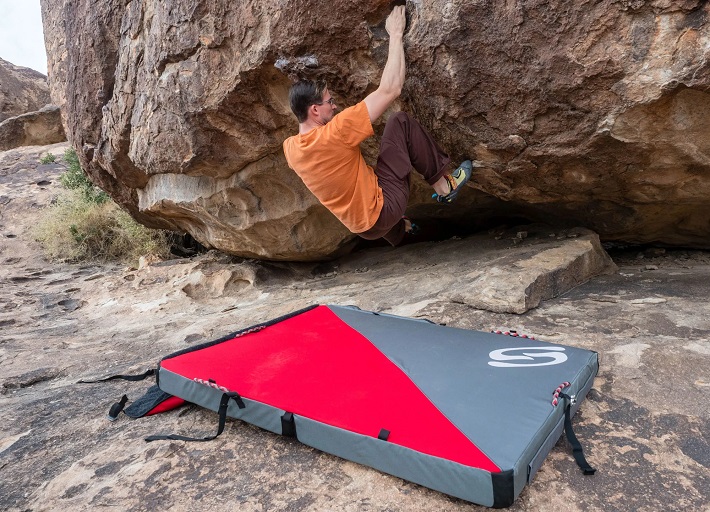
A climbing crash pad takes plenty of punishment before you even make your first move on the wall. It gets dragged across rocks, folded repeatedly, squeezed into the car and exposed to dirt and rough outdoor terrain. That makes reinforcement and protection just as important as the foam inside.
Durable Outer Shell
Start with the outer shell. A tough, abrasion-resistant fabric helps protect the foam from sharp rocks, rough ground and daily wear. Pay particular attention to the underside, as this is the part most likely to come into direct contact with uneven terrain. A reinforced base can help prevent premature damage when you move the pad between problems.
Strong Seams and Stitching
The stitching deserves attention, too. Reinforced seams and strong stitching can help the pad withstand repeated folding, unfolding and carrying. Weak points around handles, straps and corners can experience considerable stress, so these areas should feel securely constructed rather than flimsy.
Protection from the Elements
Outdoor climbing also exposes your crash pad to dust, moisture and changing conditions. A water-resistant or easy-to-clean outer material can make the pad more practical for regular use. It won’t replace proper storage or care, but it can help prevent everyday exposure from becoming a major problem.
Handles and Straps
Don’t overlook the carrying system. Handles and backpack-style straps need to support the pad’s weight without becoming uncomfortable or pulling the seams. If you’re hiking to remote boulders, this becomes especially important.