By definition, long‑range shooting is precision at a distance. If you’re confident at shorter ranges, this discipline is the next logical step, challenging your skills further. However, distance also adds complexity. Mathematics, ballistics, and wind all come into play as targets move further out.
No worries, though. Today, almost anyone with a smartphone can use ballistics apps to calculate bullet drop and wind correction with impressive accuracy. But even the most accurate apps, the steadiest hands, and the keenest eye require the support of quality equipment. Long-range shooting demands specialized gear that enhances the shooter’s skills and compensates for the challenges of extended distances.
Long-Range Rifles
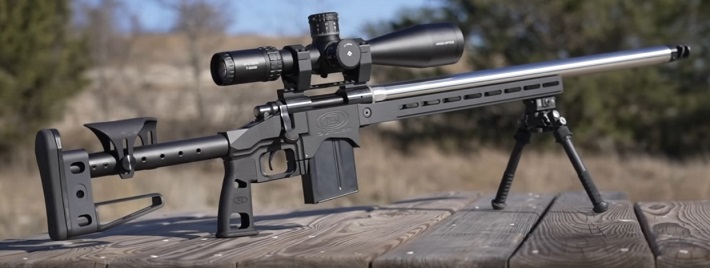
When stretching your range, one of the most important decisions you’ll make is choosing a reliable long range shooting rifle. Such a firearm prioritizes consistency, stability, and precision. There are several types to consider, with the most common being bolt-action and semi-automatic. Here’s what to look for in a long‑range rifle:
Action Type
Renowned for their precision, bolt-action rifles are the preferred choice for many long-range shooters. That’s because their simple, manually operated design usually involves fewer moving parts, which can help minimize mechanical variation and support consistent accuracy.
Modern semi-autos, on the other hand, might not always be as inherently precise as bolt-action rifles. However, with advancements in technology, they approach the accuracy of bolt-action rifles. Their main advantage is that they offer faster follow-up shots, which can be crucial in situations requiring rapid engagement, such as certain long-range competitions or hunting scenarios.
Calibers
To ensure optimal performance of your long range shooting rifle, you need to choose the best calibre for your specific shooting scenarios and your skills. Selecting the right calibre is crucial for maximizing range, accuracy, and energy retention.
One of the most popular options for long-range shooting is the 6.5 Creedmoor due to its high ballistic coefficient, low recoil, and excellent consistency at 1,000+ yards.
.308 Winchester is another option with proven performance at extended ranges. While it has more drop and wind drift than the 6.5 Creedmoor, it remains a versatile and reliable choice. Moreover, .308 Winchester has excellent barrel life, allowing shooters to shoot a high volume without worrying about burning out their barrel.
Designed for extreme long-range precision, the .300 PRC offers superior velocity and energy retention. This makes it an ideal choice for competition and big-game hunting.
.338 Lapua Magnum: A powerhouse designed for ultra-long-range shooting, with effective reach beyond 1,500 yards. Commonly used in ELR (Extreme Long Range) competitions and military applications.
Barrel Length
Barrel length for long‑range applications typically ranges between 24 and 28 inches. A longer barrel helps maximize velocity, which reduces drop at extended distances. Heavier‑profile barrels also resist heat distortion, helping maintain accuracy over multiple shots.
Optics
Next, optics also become part of your setup when stretching your range beyond short distances. With that in mind, most long range rifles are usually scope‑ready, with drilled and tapped receivers or integrated rails that allow you to mount adjustable optics.
From there, the choice of optic comes down to how far you plan to shoot and the level of precision you’re aiming for. Optics come in different magnification ranges. Lower magnification offers a wider field of view and quicker target acquisition, while higher magnification allows for more precise aiming at extended distances.
Reticles also vary in design and complexity. Some are simple and uncluttered, while others include reference marks that help with holdovers and wind estimation. The choice often comes down to how much visual information you prefer in your sight picture.
Ammunition
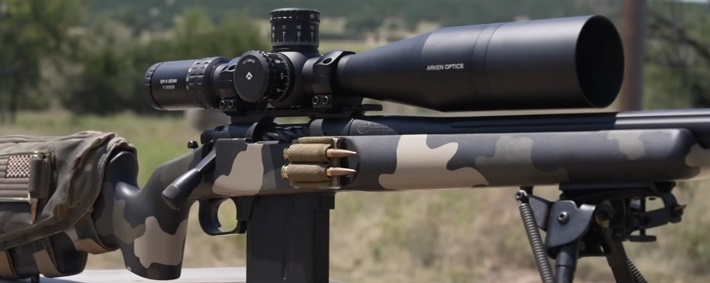
Just as the rifles used for this type of shooting are often purpose‑built, the ammunition is also designed with long‑range performance in mind. It’s optimized to maintain accuracy and stability beyond typical shooting distances.
Long-range cartridges must retain several elements to be successful. First is propellant capacity. A cartridge with a larger case volume can hold more propellant. This gives the bullet more sustained push as it travels down the barrel, helping it reach and maintain higher, more consistent speeds. At long distances, that consistency matters because it helps the bullet stay stable in flight and reduces how much small variations affect accuracy.
The second is a projectile with a high ballistic coefficient, designed to travel efficiently while carrying enough weight to remain balanced and stable in flight. When these requirements come together, only a select group of cartridges truly fit the long‑range profile.
Accessories
Long-range shooting is more than the rifle and scope. Accessories can also enhance your experience. For instance, a stable rifle bipod helps reduce movement, fatigue, and improve accuracy. Look for sturdy models made from steel or high‑grade aluminum with firm locking points. Depending on your shooting environment, bipods may come with rubber feet for slick surfaces, spiked feet for dirt or gravel. There are also options with legs that rotate and pivot slightly to accommodate uneven ground.